The best heater for a studio apartment is a compact model that can warm the area you use without taking up much floor space. The DREO 1500W ceramic heater is best for quiet heating with listed safety features, while the WINHL is better for remote operation and oscillation. For a taller tower design, consider the DREO 25-inch model or the 37-inch ceramic tower. The 24-inch oscillating heater is a space-saving option with a stated 200-square-foot coverage area.
| Heater | Best For | Notable Listed Details |
|---|---|---|
| DREO 1500W Ceramic | Quiet use and safety features | 34 dB, 270-square-foot coverage, tip-over protection |
| WINHL Oscillating | Remote adjustments | 70-degree oscillation, remote control |
| DREO 25-Inch | Quiet tower-style heating | 25 dB, child lock, tip-over protection |
| 37-Inch Ceramic Tower | Buyers seeking a taller tower | Product details provided do not specify performance or controls |
| 24-Inch Oscillating | Compact coverage with remote access | 200-square-foot coverage, 70-degree oscillation |
DREO 1500W Ceramic Heater

This DREO heater is best for studio residents who want a compact electric heater with a stated coverage area, quiet operation, and several built-in safety features. Its 1500W PTC ceramic heating is described as warming spaces quickly, and the listed coverage is 270 square feet. That makes the stated area relevant to buyers comparing a heater with the size of an open studio.
The manufacturer lists noise at 34 dB and describes the airflow design as quieter than traditional electric heaters. Listed safety details include smart tip-over protection, overheat protection, V0 flame-retardant materials, a 12-hour timer, and automatic power-off after 24 hours without interaction. The heater also has a six-foot flat power cord.
- Best for: Buyers prioritizing quiet operation, stated room coverage, and multiple listed safety features.
- Why it was selected: It combines a specific coverage figure with ceramic heating and useful safety details.
- Limitation: The instructions say not to use an extension cord; plug it directly into a wall outlet.
WINHL Oscillating Space Heater

The WINHL portable heater is best for someone who wants to adjust heating settings from across a studio. Its listed remote controls temperature, fan speed, heating modes, and timer settings. This can be useful when the heater is positioned away from a desk, bed, or seating area.
PTC ceramic heating is described as providing fast warmth for small spaces. The 70-degree automatic oscillation moves warm air across a wider area than a heater aimed in one direction. The product information identifies bedrooms, offices, and living rooms as suitable settings, but it does not provide a square-foot coverage estimate.
- Best for: Buyers who value remote control and moving airflow in a small room.
- Why it was selected: Its oscillation and remote functions address common convenience needs in a single-room apartment.
- Limitation: The remote requires two AAA batteries, which are not included. A coverage figure is not provided in the supplied details.
DREO 25-Inch Quiet Tower Heater

This 25-inch DREO model is best for buyers who prefer a taller heater and place a high value on quiet operation. The product information lists noise as low as 25 dB and describes an airflow design intended for quiet use in bedrooms or offices. Its stated heating speed is 11.5 feet per second, and the extended impeller is described as doubling the heat range. The listing positions it for large rooms, though it does not give a square-foot coverage figure in the supplied information.
Safety details include V0 flame-retardant material, a reinforced plug, tip-over and overheat protection, and a child-lock setting. The product description says its tip-over protection is tested at a 45-degree angle and notes ETL certification.
- Best for: Studio residents seeking a tower-style heater with very low listed noise and child-lock functionality.
- Why it was selected: Its quietness and safety details distinguish it from simpler portable options.
- Limitation: No specific coverage area is supplied, so compare the product’s current specifications with your room before choosing.
37-Inch Ceramic Tower Heater

This 37-inch ceramic tower heater is best for shoppers specifically looking for a taller tower format. Its name identifies a ceramic heater with a 3D flame design, oscillation, and remote control. The product title also names tip-over and overheating protection. These details may help buyers compare the general form and advertised functions with shorter heaters.
The supplied product information does not include a heating wattage, coverage area, noise level, timer details, or control settings beyond the remote and oscillation named in the product title. Those omissions make it harder to compare its heating capacity with the other options here. Check the full listing for those specifications before deciding whether it suits your studio’s size and use.
- Best for: Buyers who want a tall tower design and value the listed oscillation and remote features.
- Why it was selected: It offers a distinct 37-inch format among the listed indoor heaters.
- Limitation: The available details do not establish its coverage, wattage, or noise level.
24-Inch Oscillating Ceramic Heater
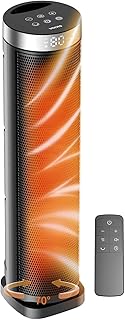
This 24-inch heater is best for studio residents who want remote operation, wide-angle oscillation, and a stated coverage area. It uses 1500W PTC ceramic heating and lists coverage of 200 square feet. Its 70-degree oscillation is described as helping distribute warm air toward room corners, which may suit an open-plan room better than a fixed-direction heater.
The heater includes a top-mounted touchscreen, a remote with a listed range of up to 25 feet, and a hidden handle for moving the compact unit. Its stated noise level is 32 dB, with a mute mode for button sounds. The product also lists a 12-hour timer and thermostat in its title.
- Best for: Buyers who want a compact tower with remote access and a clear coverage estimate.
- Why it was selected: The 200-square-foot figure, oscillation, and portability details make it straightforward to compare for studio use.
- Limitation: The remote requires two AAA batteries, which are not included; its five-foot cord may affect placement.
Buying Guide: How To Choose A Studio Apartment Heater
How much coverage does your studio need?
Start with the floor area you want to heat, not simply the total apartment size. In an open studio, the kitchen, sleeping area, and living space may share air, but doors, drafts, and room layout can affect how evenly warmth spreads. Among these five options, the DREO 1500W model lists 270 square feet of coverage, while the 24-inch model lists 200 square feet. The other supplied details do not state a coverage figure.
Treat a manufacturer’s coverage figure as a comparison point rather than a guarantee that every corner will feel equally warm. If your apartment is larger than the stated area, has high ceilings, or has significant drafts, a portable heater may not warm the entire space uniformly. A heater can also be used to warm the area where you spend time rather than the entire apartment.
Should you choose a tower or a compact heater?
A tower shape can take up less floor area than a wider unit, but dimensions and placement still matter. The 24-inch heater includes a hidden handle and a stated five-foot cord. The 25-inch DREO and 37-inch model offer taller formats. Compare the heater’s footprint and height with available floor space, furniture, and the location of a suitable wall outlet.
Do not place a heater where it blocks a walkway or can be easily knocked over. Follow the manufacturer’s instructions for clearances and safe placement. The product details provided here do not give the exact dimensions or clearance requirements for every model, so check the full instructions before use.
Is oscillation useful in an open-plan room?
Oscillation moves airflow across a broader angle instead of directing it continuously toward one spot. The WINHL heater lists 70-degree automatic oscillation, as do the 24-inch heater’s product details. The 37-inch model’s title also identifies it as oscillating. This feature may help spread warm air across a seating or work area, but it does not replace choosing a heater with suitable coverage.
How important are noise and remote controls?
Noise can matter when a heater is used near a bed or desk. The listed noise figures are 25 dB for the DREO 25-inch model, 32 dB for the 24-inch heater, and 34 dB for the DREO 1500W model. These figures come from product information and may be measured under particular conditions. The WINHL and 37-inch model details supplied here do not include noise figures.
A remote can be convenient when the heater is across the room. The WINHL remote adjusts temperature, fan speed, modes, and timer settings; the 24-inch model lists remote operation up to 25 feet. Remember that both remote-control product descriptions specify AAA batteries that are not included.
Which safety details should you compare?
Look for the safety features actually identified for each model, then read the manufacturer’s instructions. The DREO 1500W heater lists tip-over protection, overheat protection, flame-retardant materials, a timer, and automatic power-off. The DREO 25-inch model lists tip-over and overheat protection, a child lock, flame-retardant material, and a reinforced plug. The 37-inch heater’s title names tip-over and overheating protection.
Safety features do not remove the need for careful use. Keep heaters away from materials that can catch fire, place them on a stable surface, and use them as directed. The DREO 1500W listing specifically says not to use an extension cord and to plug the heater directly into a wall outlet. Check each product’s complete instructions for its electrical and placement requirements.
How should you compare power and convenience?
Two models in this selection list 1500W: the DREO ceramic heater and the 24-inch oscillating heater. The other supplied descriptions do not state wattage. Wattage is useful for comparing electrical demand, but it does not by itself establish how evenly a heater will warm your particular apartment. Compare the listed power, room coverage, controls, noise information, cord length, and safety instructions together.
Consider how you will actually use the heater. A timer can be helpful for scheduled operation, while a thermostat may help manage a chosen temperature. The 24-inch heater’s title lists a thermostat and 12-hour timer; the DREO 1500W details list a 12-hour timer and 24-hour automatic power-off. Do not assume a feature is present when it is not listed in the product information.
Frequently Asked Questions
What wattage is suitable for a studio apartment heater?
Wattage alone cannot determine whether a heater will suit a studio. Compare its stated coverage with the area you want to heat, along with room layout, electrical requirements, and manufacturer instructions. Two heaters in this selection list 1500W.
Which listed heater has the largest stated coverage?
The DREO 1500W ceramic heater lists coverage of 270 square feet. The 24-inch oscillating heater lists 200 square feet. The supplied details for the other models do not specify a square-foot coverage area.
Which heater is listed as the quietest?
The DREO 25-inch heater has the lowest stated noise figure among products with supplied noise data: as low as 25 dB. The DREO 1500W model lists 34 dB, and the 24-inch model lists 32 dB.
Do oscillating heaters work well in a studio?
Oscillation can move warm airflow across a wider area than a fixed-direction heater. It may be useful in an open-plan studio, but coverage, placement, and the room layout also affect how evenly the space warms.
Can I use an extension cord with these heaters?
The DREO 1500W heater’s supplied safety instructions say not to use an extension cord and to plug it directly into a wall outlet. For other models, follow the full manufacturer instructions rather than assuming an extension cord is permitted.