The best low-wattage panel heater depends on whether you need quiet supplemental warmth for a room or targeted heat for one person. The 180W FrauSonne is the lowest-wattage listed wall panel, while the 250W Amaze and EconoHome models are options for small rooms. ENVI stands out for its fanless design and wall-sense safety sensor. Compare the listed heating area, controls, installation requirements, and safety details before choosing; low wattage does not necessarily mean a heater can warm an entire room on its own.
| Product | Listed power | Best suited for |
|---|---|---|
| FrauSonne 180W Panel | 180W | Low-power, localized warmth |
| Amaze Ultraslim Wall Heater | 250W | Small rooms and wall mounting |
| EconoHome Convection Panel | 250W | Small-room heating with a thermostat |
| ENVI Plug-in Panel Heater | Not specified in supplied details | Quiet, continuous supplemental warmth |
| FrauSonne 350W Panel | 350W | More output for a small area |
FrauSonne 180W Infrared Panel Heater

Best for: Buyers prioritizing low power draw and gentle, localized warmth. At 180 watts, this is the lowest-wattage indoor wall panel in this selection. The supplied details describe infrared heating for spaces of 3–6 square meters and one-switch operation, without complicated settings.
The panel can be wall- or ceiling-mounted to save floor space. A 1.8-meter power cable and wall-mounting kit are included. Ceiling installation requires additional hardware that is not included. The product information also states that the heater reaches 248°F (120°C) in three minutes, so placement and installation deserve attention.
Why it was selected: Its listed wattage is lower than the other indoor wall panels here, making it a relevant choice for buyers comparing low-power options. Limitation: The stated coverage is small, and the simple on/off control does not offer a thermostat or timer in the supplied feature list. Avoid choosing it as a substitute for whole-home heating without checking the room’s needs.
Amaze Ultraslim 250W Wall Heater

Best for: Buyers who want a compact, wall-mounted panel for a small indoor space. The Amaze heater uses 250 watts and is listed for rooms up to 80 square feet. Its 18-by-24-inch panel is one inch deep, and the feature list identifies bedrooms, bathrooms, and RVs as possible settings.
The panel is described as triple insulated and made with non-conducting materials. Its paintable surface can blend with a wall, and reinforced fiberglass mats are intended to help resist cracking. The listed electrical specifications are 120 volts, 2.08 amps, and 853 BTU per hour.
Why it was selected: It combines a clearly stated wattage and small-room coverage with a slim wall-mounted format. Choose it if those dimensions and the listed 80-square-foot limit fit your space. Limitation: Its stated coverage is smaller than the 250W EconoHome model’s listed coverage, and the feature details do not list a thermostat or adjustable heat settings.
EconoHome 250W Convection Wall Heater
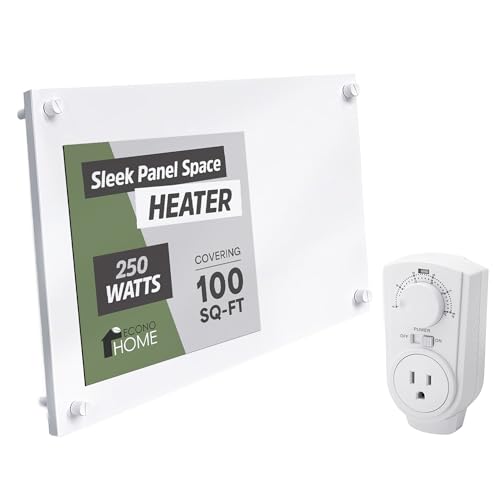
Best for: Buyers looking for a low-wattage wall panel with a thermostat and a stated room size around 100–120 square feet. The product name and specifications list 250 watts, 120 volts, and 2.08 amps. Its thermostat range is 41–86°F, and the heater produces mostly convection heat along with some radiant heat.
The 24-by-18-inch panel is described as paintable, triple insulated, and reinforced to resist cracking. Mounting hardware is included. The feature list says the unit is cETL approved and identifies it as IP44 splash proof, but also says to keep it 12 inches from water. It may be hardwired.
Why it was selected: It offers more listed coverage than the 250W Amaze panel and includes a thermostat, making it the better match for buyers who want temperature adjustment. Limitation: The casing becomes warm and the product details describe it as safe for adults only. Check installation instructions and keep the required distance from water.
ENVI Plug-In Fanless Panel Heater

Best for: Buyers who value quiet, fanless supplemental heating. ENVI describes this wall-mounted panel as suitable for targeted comfort and continuous operation. Its convection design does not blow dust or allergens around, according to the supplied product information, and it is described as helping maintain indoor humidity.
A wall-sense safety sensor cuts power if the heater is removed from the wall. The listed surface operating temperature is 90°F, and an auto-dimming power light is intended to reduce distraction. The feature list also highlights a two-minute installation, although buyers should consult the product instructions for the actual mounting steps.
Why it was selected: Its fanless operation and wall-removal sensor differentiate it from basic low-wattage panels, particularly for bedrooms or spaces where fan noise is unwelcome. Limitation: The supplied features do not state its wattage or a specific room-size rating. Confirm those details before comparing its energy use or expected coverage with a heater that lists both.
FrauSonne 350W Infrared Panel Heater

Best for: Buyers who want an infrared panel with more listed output than the 180W model while still choosing a relatively low-wattage heater. This unit is rated at 350 watts and is described as suitable for spaces of 3–8 square meters. Its one-switch control is simple to operate.
The heater can be installed on a wall or ceiling, and the package includes a 1.8-meter power cable and wall-mounting kit. Ceiling installation requires additional hardware that is not included. The product features describe graphene heating technology and state that the panel reaches 248°F (120°C) in three minutes.
Why it was selected: It offers a higher wattage and larger stated area than the matching 180W panel, so it may suit buyers who want more output for a small space. Limitation: It has only on/off control in the supplied information, with no listed thermostat or timer. Its stated heated area is still modest, so compare it with room dimensions and heating expectations.
Buying Guide: How to Choose a Low-Wattage Panel Heater
What wattage is right for the space?
Start with the heater’s stated wattage and intended coverage, then consider whether you need localized warmth or heat for an entire room. The 180W FrauSonne is the lowest-wattage indoor panel listed here, while the 250W models offer different features and coverage claims. The 350W panel has more output than the 180W option, but its stated coverage remains limited to a small area.
Published coverage is a guide, not a guarantee that a heater will maintain a comfortable temperature in every room. Insulation, drafts, ceiling height, outdoor temperatures, and the room’s layout can affect results. A low-wattage panel may be more appropriate as supplemental heat than as the only source of warmth in a larger or poorly insulated space.
Do you want infrared or convection heat?
Infrared panels are described as directing radiant warmth, while convection panels warm air as it circulates around the heater. In this selection, the FrauSonne panels use infrared heating; the EconoHome panel is described as producing mostly convection heat with some radiant heat. ENVI uses a fanless convection design. Choose based on the type of comfort you want, but do not assume that one heating method will always use less electricity at the same wattage.
Which controls matter for everyday use?
Simple on/off operation can suit buyers who want straightforward control, as with the FrauSonne panels. The EconoHome 250W model lists a thermostat that adjusts within a 41–86°F range. ENVI emphasizes continuous operation and a wall-sense sensor, but the supplied features do not state a wattage or room-size rating. Verify control details before selecting a heater for overnight or scheduled use.
Should you choose a wall-mounted or portable heater?
Wall-mounted panels can save floor space and keep the heater in a fixed location. The Amaze, EconoHome, ENVI, and FrauSonne products are designed for wall mounting. Some can also be ceiling-mounted, but the FrauSonne feature details state that ceiling installation requires additional hardware. A fixed panel is less convenient to move between rooms than a portable heater, so consider where you expect to use it most.
What safety and installation details should you check?
Read the manufacturer’s installation and clearance instructions before mounting any electric heater. Check whether the product requires hardwiring, what hardware is included, and whether it has a sensor, overheat protection, or a specified distance from water. Do not treat a general safety description as a substitute for the product manual or local electrical requirements.
Surface temperature also matters, especially in homes with children, older adults, or pets. The EconoHome feature list notes that its casing becomes warm and describes it as safe for adults only. The ENVI listing describes a 90°F surface and a sensor that cuts power when the unit is removed from the wall. Confirm that the specific heater’s instructions fit the intended room and users.
How should you compare energy use?
Wattage indicates the heater’s electrical power while operating; it does not by itself predict the cost of heating a room. To estimate energy use, multiply watts by operating hours and divide by 1,000 to get kilowatt-hours. For example, a 250W heater operating for four hours uses 1 kilowatt-hour of electricity, before accounting for thermostat cycling or other operating conditions.
Compare the wattage, expected run time, controls, and the amount of space you need to heat. A lower-wattage model may use less electricity per hour but may not provide enough warmth for a larger or colder room. A thermostat can help manage operation, while a basic on/off panel requires the user to control when it runs.
Frequently Asked Questions
What is the lowest-wattage indoor panel heater in this selection?
The FrauSonne infrared panel is listed at 180 watts. Its stated suitable area is 3–6 square meters, so it is intended for a small space rather than broad room heating.
Can a 250W panel heater heat a whole room?
It depends on the room and the product’s stated coverage. The Amaze model is listed for up to 80 square feet, while the EconoHome model is described for about 100–120 square feet. Actual performance can vary with insulation, drafts, and room conditions.
Which listed heater has a thermostat?
The EconoHome 250W convection panel lists a thermostat with a temperature range of 41–86°F. The supplied details for the FrauSonne panels describe one-switch operation rather than thermostat control.
Is a fanless panel heater quiet?
ENVI describes its panel as fanless and silent, making it a relevant choice for buyers who want to avoid fan noise. The supplied product details do not provide a measured noise level.
Can a wall panel heater replace central heating?
These products are generally presented for small spaces, targeted comfort, or supplemental heating. Check the heater’s stated coverage and your home’s heating needs before relying on a low-wattage panel as a primary heat source.