For camper heating, choose a heater only if its fuel type, installation, and operating instructions are suitable for the specific vehicle and space. The AHUAWA and Sengoku models are compact kerosene options; the sxvbdway adds a cooking surface; Mr. Heater is a propane alternative; and the YZO is a diesel air-heater option. A product listing’s claim of indoor or RV use does not, by itself, establish that a heater is safe to operate inside an enclosed camper. Follow the manufacturer’s instructions and camper safety requirements before use.
| Product | Best suited for | Fuel | Key listed feature |
|---|---|---|---|
| AHUAWA 10,000 BTU Heater | Buyers wanting a portable, non-electric kerosene option | Kerosene | Listed 1.4-gallon tank and up to 20 hours of heat |
| Sengoku HeatMate 110 | Buyers prioritizing a compact design and push-button start | Kerosene | Listed runtime up to 14 hours |
| sxvbdway 9,000 BTU Heater | Buyers interested in a heater with a cooking surface | Kerosene | Listed 4.5-liter capacity |
| Mr. Heater Portable Buddy | Buyers open to a portable propane alternative | Propane | 4,000- or 9,000-BTU heat settings |
| YZO 8KW Diesel Air Heater | Buyers considering a vehicle-oriented diesel system | Diesel | Multiple voltage options and remote control |
AHUAWA 10,000 BTU Kerosene Heater

Best for: Buyers who want a portable kerosene heater that does not require electricity to produce heat. The listing describes a 9,000–10,000 BTU output and says it can heat spaces from 200 to 500 square feet. That range is broad, so camper owners should compare the actual space and conditions with the heater’s manual rather than treating the largest figure as a guaranteed result.
The product listing specifies a 1.4-gallon tank and up to 20 hours of operation. It also says the package includes a funnel, siphon pump, gloves, and extra wicks. Those accessories may make fuel handling and routine wick replacement more convenient, but they do not replace the need to follow the heater’s directions.
Why it was selected: Its listed compact, electricity-free operation and stated runtime make it relevant to shoppers comparing portable kerosene options for camping or emergency planning.
Limitation: The listing’s indoor and RV wording is not enough to establish safe use inside an enclosed camper. Check the manufacturer’s operating requirements and the vehicle’s rules before considering it for that setting.
Sengoku HeatMate 110 Portable Heater

Best for: Buyers looking for a portable kerosene model with a stated push-button start and automatic safety shut-off. The listing describes the HeatMate 110 as compact and easy to carry, with indoor and outdoor use mentioned in its product details.
The heater has a listed 1.2-gallon tank and can run for up to 14 hours, according to the supplied product information. Its push-button start is described as not requiring matches or electricity. This makes it a useful comparison for shoppers who value straightforward starting and a runtime figure shorter than the AHUAWA model’s stated maximum.
Why it was selected: It is a recognizable portable kerosene option in the supplied product list, and the automatic shut-off and push-button start are specific features that distinguish it from models whose listings do not mention those controls.
Limitation: A safety shut-off does not make a heater suitable for every camper interior. Confirm allowed use, clearances, ventilation requirements, and operating procedures in the manufacturer’s instructions.
sxvbdway 9,000 BTU Heater And Stove
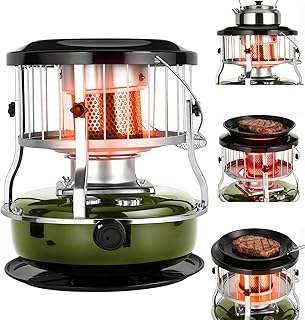
Best for: Buyers comparing a kerosene heater with a top surface intended for cooking. The listing presents this product as a 2-in-1 heater and stove, with a 9,000 BTU output and a 4.5-liter fuel capacity. It also claims a heating area of up to 15 square meters and a burn time of 16 to 21 hours.
The no-electricity design may appeal to shoppers preparing for situations where power is unavailable. Its cooking feature is the key distinction from the other listed kerosene heaters. However, a cooking surface should not be assumed to be suitable for every meal, vessel, or indoor environment. Follow the product’s specific directions for both heating and cooking.
Why it was selected: It is the most clearly described dual-purpose kerosene option in this group, which may matter to buyers comparing equipment for camping or emergency supplies.
Limitation: The listing does not provide enough detail here to establish camper-specific installation or ventilation suitability. Do not infer that portable or non-electric means safe to operate inside an enclosed vehicle.
Mr. Heater Portable Buddy Propane Heater

Best for: Buyers who are willing to compare a propane heater instead of restricting their search to kerosene. The listed output settings are 4,000 or 9,000 BTU per hour, and the product information says it can heat approximately 225 square feet. It is described as designed and approved for indoor and outdoor use, but owners should still verify the current manual’s requirements for their specific location.
This product provides a useful fuel-type comparison. It does not use kerosene, so buyers should consider fuel availability, storage, and the instructions for the exact propane setup. Its stated heating area is more specific than the broad range given for some of the kerosene options.
Why it was selected: It is a portable radiant-heater alternative for shoppers whose main goal is camper-area warmth rather than kerosene specifically.
Limitation: It uses propane, not kerosene. Confirm the manual’s indoor-use conditions and any camper or campsite restrictions before operating it.
YZO 8KW Diesel Air Heater

Best for: Buyers considering a diesel air-heater system for a vehicle or camper, rather than a small freestanding kerosene heater. The listing describes 12V and 24V vehicle power support and includes a 110–240V transformer. It also lists a thermostat, programmable timer, preheating, remote control, and overheat protection.
The product details state a 9-liter tank and a maximum runtime of up to 24 hours. They also list fuel consumption of 0.16–0.62 liters per hour and describe three installation-base options: a rubber-bottomed base, a metal base, and a removable arrangement. These are useful points to compare when researching a vehicle-oriented system.
Why it was selected: It gives buyers a diesel-based alternative to portable kerosene heaters, with vehicle power options and controls specifically identified in the listing.
Limitation: It is not a kerosene heater, and its stated power options and bases do not establish that a particular installation is safe or compatible with a camper. Installation and exhaust instructions are essential; consult the manufacturer before purchase or use.
Buying Guide: How To Choose A Camper Heater
Is a portable kerosene heater suitable for a camper?
Start with the exact heater manual and the camper manufacturer’s guidance. A listing may describe a product as suitable for indoor use, RVs, or emergencies, but those phrases do not answer every vehicle-specific question. Check whether the instructions explicitly allow the intended setting and explain ventilation, clearances, placement, refueling, shutdown, and storage. If the directions do not clearly address camper use, do not assume the heater is appropriate for an enclosed vehicle.
Fuel-burning heaters can create combustion byproducts, including carbon monoxide. Use a working carbon monoxide alarm in the camper and follow its instructions, while recognizing that an alarm is not a substitute for correct equipment and operation. Keep the heater away from bedding, curtains, clothing, and other combustible materials, and never leave it operating unattended unless the manufacturer explicitly permits that use.
How much heat output should you compare?
Compare the listed BTU output with the heater’s stated coverage, but treat coverage as an estimate rather than a promise. The AHUAWA listing gives a 9,000–10,000 BTU range and a wide 200–500-square-foot estimate. The Mr. Heater listing specifies 4,000 or 9,000 BTU per hour and approximately 225 square feet. The sxvbdway listing gives 9,000 BTU and up to 15 square meters. Different claims may use different assumptions, so they are not directly equivalent measures of performance in a camper.
Camper size, insulation, outdoor temperature, drafts, and interior layout affect heating needs. Choose based on the vehicle’s actual space and the manufacturer’s stated limits, not simply the highest output number. A heater that is too large or used in a prohibited location can create risks rather than improve comfort.
Should you choose kerosene, propane, or diesel?
- Kerosene: The three listed options operate without electricity for heat and provide stated tank capacities or runtimes. They are portable-style products, so confirm that the precise model is allowed for the intended enclosed space.
- Propane: The Mr. Heater option offers two listed output settings and a stated coverage estimate. It uses a different fuel, so review fuel handling and operating instructions for the actual configuration.
- Diesel: The YZO listing describes a vehicle-oriented system with several power options and controls. It is a different type of setup from a freestanding kerosene heater, and correct installation is a central consideration.
Fuel choice affects how you store, transport, and replenish fuel, as well as the equipment and installation requirements. Compare those practical factors with the manufacturer’s instructions and applicable campground or vehicle rules.
How important are runtime and tank capacity?
Listed runtime helps estimate how often refueling may be needed, but it is not a guarantee of the actual time between refills. The AHUAWA product lists up to 20 hours from a 1.4-gallon tank; the Sengoku lists up to 14 hours from a 1.2-gallon tank; and the sxvbdway lists 16 to 21 hours from a 4.5-liter capacity. The YZO diesel listing claims up to 24 hours and lists a 9-liter tank.
Burn time can depend on operating level and conditions. Check the manual for refueling steps, allowed fuel, fuel storage, and whether the heater must be fully cool before handling fuel. Never refuel a hot or operating heater unless its instructions explicitly describe a safe procedure.
Which controls and safety features matter?
Compare features that are explicitly listed, such as the Sengoku’s automatic safety shut-off and push-button start, the YZO’s thermostat and overheat protection, or the included accessories for the AHUAWA. These features may improve convenience or provide a specific control function, but no single feature proves that the whole setup is safe for a camper.
Read the complete manual before buying. Look for clear directions on placement, ventilation, safe clearances, ignition, shutdown, maintenance, and emergency procedures. If a product page leaves an important requirement unclear, contact the manufacturer rather than filling the gap with assumptions.
What should camper owners check before traveling?
- Confirm that the heater is allowed by the camper manufacturer, campsite, and local rules.
- Check the product’s exact fuel type, operating conditions, and installation requirements.
- Use and maintain carbon monoxide alarms as directed, and understand what to do if an alarm sounds.
- Keep fuel in approved storage and away from heat sources, following all applicable instructions.
- Inspect the heater and any required installation components before each trip.
- Plan for heating alternatives if the chosen model cannot be used safely in the camper’s interior.
For longer trips, convenience should not outweigh clear installation and safety guidance. A heater that is easier to carry or promises a longer runtime is not automatically the better choice if its instructions do not fit the vehicle.
Frequently Asked Questions
Can I run a kerosene heater inside a camper?
Only if the specific heater’s instructions and the camper’s requirements allow that exact use. Do not rely on a product listing’s general indoor-use claim alone. Follow all ventilation, clearance, placement, and operation directions.
Which listed kerosene heater has the longest stated runtime?
The AHUAWA listing claims up to 20 hours, while the sxvbdway listing claims 16 to 21 hours. These are product-page estimates, not guaranteed runtimes, and may depend on operating conditions.
Does the Mr. Heater Portable Buddy use kerosene?
No. The listed Mr. Heater Portable Buddy is a propane radiant heater. It is included as an alternative for buyers comparing fuel types.
Is the YZO diesel heater a mini kerosene heater?
No. It is listed as a diesel air heater. Its vehicle power options and installation features make it a separate category from portable kerosene heaters.
Does a safety shut-off make a heater safe for overnight use?
Not by itself. Follow the manufacturer’s directions for unattended or overnight operation, and do not assume a shut-off feature overrides ventilation, placement, or vehicle-use requirements.
What is the first thing to check before buying a camper heater?
Check whether the exact model is permitted for the intended camper setting and whether its manual provides complete instructions for safe operation and installation. Then compare fuel, output, runtime, and controls.