Power roof vents are essential for controlling ventilation, humidity, and comfort in RVs, campers, and trailers. This guide highlights five reliable powered roof vents that suit different setups—from high airflow to solar-assisted operation. Each option is evaluated for who benefits most, plus practical caveats to consider before purchase.
Buyer note: The top picks below emphasize powered operation, including 12V electric fans and solar-assisted models. They’re ideal for RV owners who want to maintain interior comfort with reliable airflow whether parked, traveling, or camping in varying weather. The quick-reference table below summarizes core specs to compare at a glance.
| Product | Brand | Best For | Power Type | Key Benefit |
|---|---|---|---|---|
| RVLOVENT 14×14 Roof Vent Fan | RVLOVENT | RVs needing strong airflow and rain-safe operation | 12V Electric | 1000 CFM with rain sensor remote |
| hurrventer Built-in Rain Shield RV Roof Fan | hurrventer | All-weather camping with quiet operation | 12V Electric | Remains operable under rain with waterproof design |
| 20 Watt Solar Roof Vent Fan (MPPT) | Hon&Guan | Off-grid spaces or solar-first setups | Solar with auto-switch to AC/DC | Auto-solar priority, thermostat control |
| 14″ RV Roof Vent For Camper Trailer (White Lid, 12V) | caqeg | Budget-friendly, standard-fit RVs | 12V Electric | Universal fit with integral garnish ring |
| HENG’S INDUSTRIES 14″ RV Roof Vent (White Lid) | HENG’S INDUSTRIES | Standard, durable powered vent with easy install | 12V Electric | Wedge lid and 14.5″ rough-cut opening |
RVLOVENT 14×14 Roof Vent Fan

Best for: RV owners requiring high airflow and rain protection. This 14×14 roof vent offers up to 1000 CFM with a remote and rain sensor, ensuring interior comfort and automatic closure during moisture. The included extra screen frame provides a ready replacement when the original gets dirty or damaged, simplifying maintenance. Caution: Installation may require proper wiring and sealing to prevent leaks.
hurrventer Built-in Rain Shield RV Roof Fan

Best for: RV owners who travel in variable weather and want continuous airflow even when it’s raining. This 12V roof fan is designed to be waterproof and quiet, with a specially engineered motor that provides efficient exhaust and intake. Caution: Product emphasizes rain-tested performance; ensure correct installation to maximize water resistance.
20 Watt Solar Roof Vent Fan with Thermostat

Best for: Off-grid spaces where solar power is preferred, such as small attics, garages, or sheds. This unit combines a 20W solar panel with a 12V fan, plus a thermostat for auto activation. It supports up to 1,100 sq ft cooling and includes an all-weather switch between solar and mains power. Caution: Solar output varies with sun; plan for backup power during low-sun periods.
14″ RV Roof Vent For Camper Trailer (White Lid)
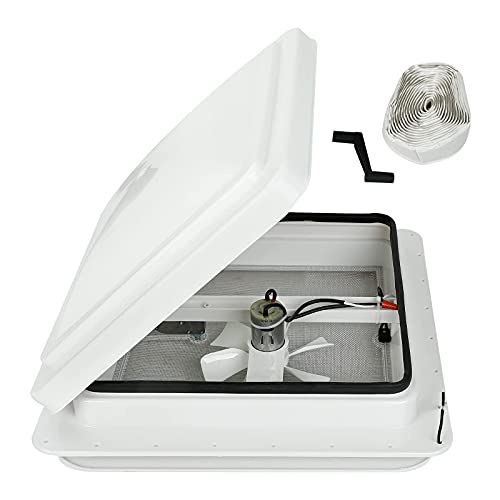
Best for: Budget-conscious RVs needing a standard 14″ vent with a 12V fan. It fits openings 14″ by 14″ and uses a white lid with a garnish ring, suitable for many travel trailers and campers. Caution: Some users may need additional sealant or mounting hardware to ensure a leak-free fit.
HENG’S INDUSTRIES 14″ RV Roof Vent

Best for: Standard RV roofs requiring a reliable powered vent with a 14.5″ rough opening. This model features a white wedge lid and a 1″ garnish ring, matching common RV roof openings. Caution: Verify rough opening dimensions and garnish compatibility before purchase.
Buying Guide: Key Purchase Considerations
What power source best fits my setup? Choose 12V fans for constant operation connected to the RV’s electrical system, or solar-assisted models if you want off-grid capability. Some units offer an auto-switching feature to prioritize solar power when available.
How much airflow do I need? Higher CFM means faster cooling but may draw more amperage. For larger RVs or hot environments, aim for models offering 800–1000+ CFM. Smaller spaces may do well with 200–400 CFM.
Is weather resistance important? If you frequently encounter rain or humidity, look for models with rain sensors or waterproof housings. A sealed, gasketed lid reduces leak risk during rainstorms.
What are the fitment requirements? Check rough opening sizes (inches) and garnish rings. Ensure the chosen vent’s dimensions align with your roof opening and the required trim pieces for a clean install.
What installation considerations exist? Some vents require extra mounting hardware, wiring, and sealants. If you’re not comfortable with roof work, consider a model that includes necessary hardware and straightforward installation instructions.
FAQ
- What is a power roof vent? A roof vent powered by electricity (12V) or solar that actively moves air in or out of an RV or trailer.
- Do solar-powered vents work at night? Solar-only operation typically stops at night; many units include a mains power option or auto-switch to maintain airflow when solar is weak.
- Can I install a powered vent myself? Yes, if you’re comfortable with roof work and basic wiring; follow manufacturer instructions and sealant recommendations to prevent leaks.
- What maintenance is needed? Regularly clean screens, check seals, and inspect for cracks or corrosion to ensure optimal performance.
- Which vent is best for all-weather use? Look for rain sensors, waterproof housings, and drip-proof wiring to reduce moisture ingress and ensure reliability during rain.
- How do I choose based on space? Measure your rough opening and compare CFM ratings to your space size to avoid undersized ventilation.