Propane torpedo heaters are generally the better fit for quickly heating garages, workshops, and job sites when you have a propane tank and suitable ventilation. Diesel air heaters are better suited to vehicle, RV, or camper applications where their fuel tank and electrical controls fit the setup. The Mr. Heater 125,000 BTU model is a straightforward high-output propane pick; the L.B. White Tradesman offers adjustable output; and the YZO diesel heater is designed around vehicle power and longer operation from its fuel tank. Compare the fuel, heat output, intended setting, and safety requirements before choosing.
| Product | Fuel | Listed output | Best suited for |
|---|---|---|---|
| Mr. Heater 125,000 BTU | Propane | 125,000 BTU | Large work areas needing portable forced-air heat |
| 150,000 BTU Forced Air Heater | Propane | 120,000–150,000 BTU/h | Buyers seeking adjustable output and listed safety features |
| L.B. White Tradesman 170 | Propane, as named | 125,000–170,000 BTU/h | Rugged work areas needing variable heat |
| YZO 8KW Diesel Air Heater | Diesel | 8KW | Vehicle and camper installations |
| InoKraft MAXHEAT MH68 | Propane | 30,000–68,000 BTU | Garages and smaller work areas |
Propane Vs. Diesel Torpedo Heaters: What Changes?
A torpedo heater is a forced-air heater that directs warm air from its outlet. In this product selection, four options use propane and one uses diesel. The diesel model is described as a portable air heater for vehicles and similar settings, rather than a conventional high-output jobsite torpedo heater. That distinction matters: fuel type is only one part of the choice. Output, installation, power source, and intended use also differ.
Propane models in the list range from 30,000 to 170,000 BTU, while the diesel heater is listed as 8KW. Do not compare those figures as if they were stated in the same unit. A buyer should match the heater’s stated output and coverage information to the space and use described by its manufacturer, rather than assuming that the largest number alone determines suitability.
Best Propane Torpedo Heaters
Mr. Heater 125,000 BTU Forced Air Propane Heater

Best for: Buyers who want a portable propane forced-air heater with a clearly stated output and a hose and regulator included. The listed heating coverage is up to 3,125 square feet, making this model a candidate for larger work areas when its specifications suit the space.
Why it was selected: The 125,000 BTU output places it among the higher-output propane choices in this selection. Its listed Quiet Burner Technology may also be relevant to buyers comparing burner design, although the product information does not provide a measured sound level.
Consider: The listing says a 10-foot hose and regulator are included, but does not say that a propane tank is included. Check the complete product details and operating instructions before purchase. Choose another option if you need a lower adjustable output; no variable output range is listed here.
150,000 BTU Adjustable Forced-Air Propane Heater
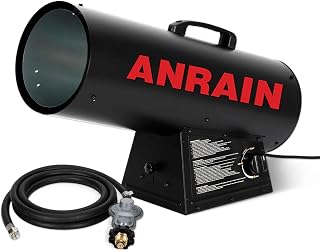
Best for: Buyers who want multiple output settings and a listed coverage figure of up to 4,305 square feet. The product information gives a 120,000–150,000 BTU/h range and low, medium, and high settings, which makes it more adjustable than the fixed-output details listed for some alternatives.
Why it was selected: It includes an 11-foot hose and regulator and lists electronic ignition, overheat protection, and automatic tip-over shutoff. The listing also states a runtime of up to 5–5.5 hours on low or 3–3.5 hours on high with a 20-pound tank; the tank is sold separately.
Consider: Runtime varies with the selected setting, and the stated times are tied to the specified tank size. Avoid choosing it based solely on the maximum coverage figure; confirm the product instructions and conditions for your planned space.
L.B. White Tradesman 170 Propane Heater

Best for: Buyers seeking a heavy-duty portable heater with variable output for a garage, shop, or construction site. The product name identifies it as an LP heater, and the listed range is 125,000–170,000 BTU/h.
Why it was selected: The listing highlights adjustable heat output, directional forced-air heat, a heavy-duty combustion chamber and burner plate, corrosion-resistant exterior, and electronic spark ignition. Those details make it a relevant comparison for work settings where variable output and rugged construction are priorities.
Consider: The product description also uses conflicting wording, including a reference to a kerosene heater. Verify the fuel specification and instructions on the product listing and unit before buying or connecting fuel. The supplied information does not specify a hose length, tank inclusion, or coverage area.
Best Diesel Air Heater For Vehicle Use
YZO 8KW Portable Diesel Air Heater

Best for: Buyers comparing diesel heating for a car, RV, truck, boat, or camper. The listing describes a 12V/24V power option and includes a 110–240V transformer, along with a 9-liter fuel tank, LCD switch, and remote control.
Why it was selected: Its listed features differ from the propane torpedo units: thermostat control, programmable timer, preheating, overheat protection, and a stated fuel consumption range of 0.16–0.62 liters per hour. The listing says the 9-liter tank can provide up to 24 hours of continuous heat, depending on use.
Consider: This is presented as a vehicle-oriented diesel air heater, not a direct like-for-like replacement for a 120,000-plus-BTU propane jobsite torpedo heater. It requires an appropriate electrical supply, and buyers should confirm installation, exhaust, and ventilation requirements in the product instructions before use.
Best Lower-Output Propane Option
InoKraft MAXHEAT MH68 Propane Heater

Best for: Buyers looking for a lower-output propane model for a garage or smaller work area. Its listed range is 30,000–68,000 BTU, and the product information gives coverage up to 1,600 square feet.
Why it was selected: The adjustable output provides a different scale from the higher-capacity jobsite models. Listed features include a forced-air fan, adjustable heat angle, overheat auto-shutoff, and automatic gas cutoff. The description says the heater can raise temperature in 10 minutes, but actual results depend on conditions and should not be assumed for every space.
Consider: Its stated maximum coverage and output are lower than those of the other propane models here. Choose a higher-capacity option if the product’s listed range does not fit your heating needs.
Buying Guide: How To Choose Propane Or Diesel
Which fuel fits the way you will use the heater?
Choose a propane model when a forced-air heater for a garage, construction site, shop, or other work area matches your needs and you can provide the specified propane supply. The four propane choices here include hose and regulator details for two models, but only one explicitly states that a tank is sold separately. Check each listing rather than assuming a tank, hose, or regulator is included.
Consider diesel when the vehicle-oriented design, fuel tank, electrical controls, and stated installation options of the YZO model suit your use. It lists vehicle power and a transformer, but it is not presented with the same BTU output range or jobsite coverage figures as the propane models. Compare products by intended application, not simply by fuel name.
How much heat output and coverage do you need?
Start with the manufacturer’s stated output and coverage, then consider the space and conditions in which the heater will operate. Among these propane options, the InoKraft is listed at 30,000–68,000 BTU and up to 1,600 square feet. The Mr. Heater is listed at 125,000 BTU and up to 3,125 square feet. The 150,000 BTU model lists up to 4,305 square feet, while the L.B. White model lists a 125,000–170,000 BTU/h range but no coverage figure in the supplied details.
Coverage figures are product claims, not guarantees for every building. Insulation, drafts, ceiling height, outdoor exposure, and the temperature you need can affect heating results. If those conditions are important, consult the manufacturer’s instructions instead of selecting by maximum coverage alone.
Is adjustable output important?
Variable output can help buyers select among different heat levels. The 150,000 BTU model lists low, medium, and high settings, the L.B. White model lists a 125,000–170,000 BTU/h range, and the InoKraft lists a 30,000–68,000 BTU range. The Mr. Heater listing provided here states a 125,000 BTU output without an adjustable range. Compare stated controls and output ranges if you expect to use the heater in spaces with different heating needs.
What should you check about runtime and fuel supply?
Runtime depends on fuel capacity, output setting, and operating conditions. The 150,000 BTU propane heater gives estimates for a 20-pound tank and explicitly says the tank is sold separately. The YZO diesel heater lists a 9-liter tank, a consumption range, and up to 24 hours of operation. These estimates are not directly interchangeable because the products use different fuel types and have different applications. Confirm fuel availability and refill needs for the setting where you plan to use the heater.
What safety and installation details matter?
Read the manufacturer’s operating and installation instructions before use. Confirm the required ventilation, clearances, fuel connections, electrical supply, and any exhaust-routing requirements that apply to the specific model and location. Never treat a product’s safety features as a substitute for following its instructions. The listed propane models mention features such as overheat protection or automatic shutoff, while the YZO listing describes overheat protection and vehicle-oriented installation options.
For any fuel-burning heater, consider carbon monoxide and fire risks. Use the heater only in locations and conditions allowed by its manufacturer, maintain required ventilation, and follow applicable safety guidance. Do not assume that a heater is suitable for an enclosed or occupied space just because its listing describes indoor or vehicle use.
How should you compare these models?
- For a high-output propane choice: Compare the Mr. Heater’s 125,000 BTU output with the variable-output models and confirm its listed coverage fits your needs.
- For multiple propane settings: Review the 150,000 BTU model’s low, medium, and high settings, runtime estimates, and separately sold tank.
- For rugged work-area use: The L.B. White listing emphasizes heavy-duty construction and variable output, but its fuel wording should be verified before purchase.
- For vehicle-oriented diesel heat: Check the YZO model’s power, fuel consumption, tank, and installation requirements; it serves a different use case from the propane torpedo heaters.
- For a lower-output propane unit: Compare the InoKraft’s listed 30,000–68,000 BTU range and 1,600-square-foot coverage with the size of your intended area.
Frequently Asked Questions
Is propane or diesel better for a torpedo heater?
Neither fuel is automatically better for every buyer. Propane models in this selection are conventional forced-air choices for work areas, while the diesel model is described for vehicles and campers. Choose based on intended use, fuel access, installation, and the product’s stated output.
Can the YZO diesel heater replace a high-output propane torpedo heater?
Not as a direct specification match based on the information provided. The YZO is listed as an 8KW vehicle-oriented air heater, while the propane models list outputs as high as 170,000 BTU/h. Their stated applications and specifications differ.
Which propane heater has the highest listed output?
The L.B. White Tradesman 170 lists an adjustable range of 125,000–170,000 BTU/h. Its description contains conflicting fuel wording, so verify its fuel specification before purchase.
Does the propane heater include a tank?
Do not assume that it does. The 150,000 BTU model explicitly says its 20-pound tank is sold separately. The Mr. Heater listing says a 10-foot hose and regulator are included but does not state that a tank is included.
Is a torpedo heater safe to use indoors?
Safety depends on the specific heater, location, and conditions permitted by its manufacturer. Follow its instructions for ventilation, clearances, and operation, and account for carbon monoxide and fire risks. Do not use a fuel-burning heater in an enclosed space unless the manufacturer explicitly allows that use.