Looking for a tankless water heater that reliably serves a 3-bedroom, 2-bath home? This guide highlights five suitable models and explains who each is best for. You’ll find electrical and gas options, compact or space-saving designs, and products suited for multi-point use. The selections aim to balance flow, install practicality, and energy efficiency for mid-sized homes.
| Product | Best For |
|---|---|
| NOVIEEX 27kW Electric | Homes with strong electrical service; multi-point use up to 3–4 points |
| WINTEMP 36kW Electric | 4–5 bathroom-equivalent demand; larger homes or higher simultaneous usage |
| 18kW Electric (ETL) | Smaller load or limited circuit capacity; 3–4 usage points |
| MIZUDO 120k BTU Gas | Whole-house gas heating with outdoor/indoor flexibility; WiFi/app control |
| Westinghouse 18kW Electric | Smart control and mid-sized homes with 3/4″ piping |
Noviex 27kW Electric Tankless Water Heater

Best for high-demand homes with robust electrical service. This unit delivers up to 7.4 GPM and supports 3–4 simultaneous points, suitable for larger households that run multiple fixtures at once. It requires 3 × 40A double-pole breakers and 8 AWG wiring. The slim wall-mount saves space compared with storage tanks.
Best for buyers who need strong, consistent hot water without preheating. Consider this if your electrical panel can accommodate the 112.5A draw and you have room for a dedicated appliance circuit. A caution: professional electrical installation is required due to high power demands.
WINTEMP 36kW Electric Tankless Water Heater

Best for larger homes near the upper end of typical 3–5 bathroom layouts. This 36kW model provides up to 8.7 GPM and uses self-modulating tech to balance power with flow. It needs a robust electrical service (300A recommended) and four 40A breakers. Space is a consideration given its 13.7″ W × 21.5″ H × 5.2″ D footprint.
Choose this if you anticipate high simultaneous demand across multiple baths. Avoid if electrical service cannot support four 40A breakers or if space is too tight for the unit’s dimensions.
18kW Tankless Water Heater Electric
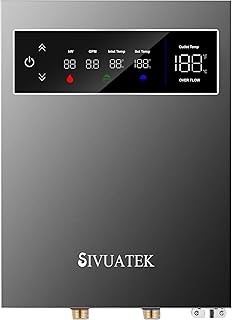
Best for homes with moderate hot water needs and limited panel capacity. It runs on 18kW, supports up to 99.8% thermal efficiency, and can deliver continuous hot water for 3–4 points. It requires two 40A breakers and standard 3/4″ NPT connections. The unit is compact and versatile for under-sink or wall installation.
Use this if you want a space-saving option with straightforward electrical requirements. A limitation is the lower maximum flow compared with higher-kW models, which may affect simultaneous fixtures in peak times.
MIZUDO 120,000 BTU Gas Tankless

Best for whole-house gas supply with flexible installation. This gas unit offers up to 5.1 GPM and features WiFi/app control for remote settings. It supports indoor or outdoor use with convertible installation and CSA certification. The model emphasizes stable output and operator convenience across multiple fixtures.
Choose this if you prefer gas-powered on-demand hot water with smart controls. A caution: gas installations typically require ventilation considerations and professional plumbing/gas work.
Westinghouse 18kW Electric Tankless

Best for mid-sized homes with smart control needs. This 18kW unit heats instantly and includes a digital LED display with Wi-Fi app support, compatible with Alexa and Google Home. It requires 240V, around 75A, and 3/4″ NPT connections. It’s a compact option for reliable on-demand hot water.
Opt for this if you want smart-home integration and straightforward installation. It may be less suitable for very high simultaneous water demands compared with higher-kW models.
Buying Guide: Key Considerations For Selecting A Tankless Water Heater
- Household demand: Estimate how many fixtures will run simultaneously and choose a unit with adequate GPM. Higher kilowatts typically support more simultaneous users.
- Electrical or gas capacity: Electric units require sufficient service amperage and multiple double-pole breakers. Gas units need proper venting and gas line sizing.
- Space and installation: Consider the unit’s dimensions and whether it will fit in a closet, utility room, or under-sink area. Wall-mount design saves space.
- Temperature stability: Some models offer advanced modulation to keep water temperature within a tight range during varying flow.
- Control features: LED displays and smart home compatibility can simplify temperature management and monitoring.
- Installation cost and code compliance: Ensure that the installation meets local electrical or gas codes and uses a licensed professional when required.
- Maintenance and durability: Look for corrosion-resistant components and accessible service options for long-term reliability.
Frequently Asked Questions
- How many GPM does a tankless heater need for a 3-bedroom, 2-bath home?
Answer: It depends on simultaneous usage. A typical setup may require 4–7 GPM for daily use, but higher-demand homes may need 8–9 GPM or more. - Do electric tankless heaters require a dedicated electrical service?
Answer: Yes. High-power electric models usually require dedicated circuits and proper breaker sizing. - Is gas or electric more cost-effective for whole-house hot water?
Answer: It depends on local energy costs, installation, and usage patterns. Gas often has lower operating costs in some areas, but electric models avoid venting and gas line work. - Can these units support multiple bathrooms at once?
Answer: Some models support 3–4 simultaneous points, while others may max out at fewer points depending on power and gas input. - What maintenance do these require?
Answer: Regular descaling (for hard water areas), periodic venting (gas models), and professional inspections as recommended by the manufacturer. - Do I need a professional for installation?
Answer: Yes. Given electrical, gas, and venting considerations, professional installation is typically required.