Finding the right thermostat for electric baseboard heaters depends on your needs for simplicity, programmability, and smart home integration. This guide highlights five reliable options, showing who each is best for and why it stands out. Whether you want basic control, precise temperature swings reduction, or full smart-home compatibility, these picks cover common residential setups. The buyer’s table below helps compare key considerations at a glance.
| Product | Best For | Why It Stands Out |
|---|---|---|
| Honeywell Home Digital Non-Programmable Thermostat (RLV3120A1005) | Basic control fans | Highly accurate temperature control; silent switching; simple two-wire installation. |
| Cadet F Series Double Pole Built-In (BTF2W, 08734) | Cadet baseboard models | Easy end-mill mounting on Cadet heaters; wide range with a large dial. |
| Cadet Double Pole Line Voltage Thermostat (Baseboard & Wall Heaters) | Replacement upgrades | Multi-volt compatibility; simple DIY replacement; robust control at 40–80°F. |
| Meross Matter Smart Thermostat (120–240V) | Smart-home lovers | Works with Matter, Alexa, HomeKit, Google, and SmartThings; remote access. |
| Honeywell Home 5-2 Day Programmable (RLV4305A1000) | Programmable schedules | 5-2 day programming for efficient daily energy use. |
Honeywell Home Digital Non-Programmable Thermostat for Electric Heat Only
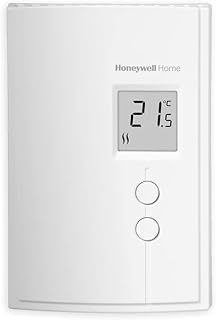
This digital, non-programmable thermostat is designed for electric baseboard heaters and convectors with two wires. It offers high precision control (± 0.27°F) and TRIAC switching for silent operation. Best for rooms that require steady, simple temperature management without scheduling. A potential limitation is the lack of programmable features for variable daily routines.
Cadet F Series Double Pole Built-In Baseboard Thermostat (BTF2W, 08734)

Designed specifically for Cadet F series baseboard heaters, this thermostat offers a wide 45–80°F range with a large, easy-to-use dial. Best for homeowners upgrading Cadet systems without rewiring. It is limited to Cadet F series compatibility, so it may not fit other baseboard models.
Cadet Double Pole Line Voltage Thermostat for Baseboard & Wall Heaters

This line-voltage thermostat supports 120, 208, and 240-volt systems, handling up to 5,280 watts at 240V. It’s suitable for replacing older wall-mounted units with a simple DIY install. Best for: users who want a robust, straightforward control with a clear 40–80°F range. A limitation is that it is a basic dial model without advanced scheduling features.
Meross Matter Smart Thermostat for Electric Baseboard Heaters

Designed for high-line voltage systems (120–240V), this smart thermostat works across Matter-compatible ecosystems (Alexa, HomeKit, Google, SmartThings) and supports remote control via Wi-Fi. It enables scheduling and energy savings with 24/7 visual programming. Best for households seeking unified smart-home control; not compatible with 24V HVAC systems.
Honeywell Home 5-2 Day Programmable Thermostat (RLV4305A1000)
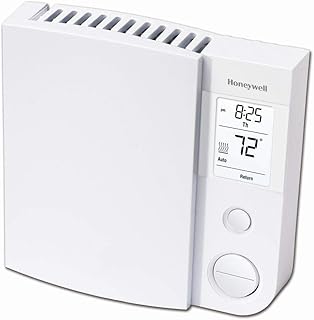
This digital thermostat offers 5-2 day programming for electric baseboards and convectors. It’s best for users who want weekly or weekday-specific schedules to optimize energy use. A potential drawback is the absence of smart-home integration, which some modern setups require.
Buying Guide: Key Purchase Considerations
- Thermostat type: Choose non-programmable for simple constant-temperature control or programmable for daily schedules that boost energy savings.
- Voltage compatibility: Confirm your baseboard system is 120V, 208V, or 240V. Double-pole models typically handle 240V or higher loads and switch both lines.
- Smart-home compatibility: If you want voice control and remote access, look for Matter support, or compatibility with Alexa, Google Home, or HomeKit.
- Installation ease: Some models are designed to replace existing units easily; others may require compatible mounting with your baseboard heater brand.
- Accuracy and noise: Digital, precision-controlled models reduce swings; look for silent switching if you prefer a quiet operation.
- Durability and compatibility: Ensure the thermostat is rated for electric baseboard heaters and not intended for hydronic or 24V systems.
Frequently Asked Questions
- What is the main difference between two-pole and single-pole thermostats?
– Two-pole (double pole) thermostats switch both hot lines, providing better safety and full circuit control, especially at 240V. - Can I install a smart thermostat on an electric baseboard heater?
– Yes, if the thermostat is rated for line voltage (120–240V) and supports your heater type; ensure Wi-Fi connectivity is available. - Is programmable always better for energy savings?
– Generally yes, because schedules align heating with occupancy, but manual thermostats can be simpler for constant comfort needs. - Do these thermostats require professional installation?
– Most line-voltage baseboard thermostats can be installed DIY if you’re comfortable with electrical wiring; otherwise, consult a licensed electrician. - Will a smart thermostat work with all baseboard models?
– Compatibility depends on voltage and wiring; verify voltage rating and the specific model’s baseboard compatibility before purchase. - Are there safety concerns with baseboard heaters?
– Use thermostats that are rated for line voltage and ensure proper clearance and wiring to prevent overheating.