The best very small kerosene heater depends on whether you prioritize compact transport, longer listed runtime, or a cooking surface. These five portable, non-electric models offer around 9,000 BTU of heat, with one listing specifying up to 10,000 BTU. The VEVOR is best for buyers who want an adjustable heater that can also support cookware; the green 9000 BTU model is best for buyers seeking a compact stated footprint. Compare tank capacity, listed runtime, and the manufacturer’s safety instructions before choosing.
| Product | Best suited for | Key listed detail |
|---|---|---|
| VEVOR 9000 BTU Portable Heater & Stove | Heating and outdoor cooking | 1.3-gallon tank; up to 20 hours listed |
| Portable 9000 BTU Radiant Heater | Buyers prioritizing a stated 4.5-liter tank | Up to 16–21 hours listed |
| Green 9000 BTU Portable Heater | Compact transport and adjustable height | 12.4-by-13.98-inch dimensions listed |
| AHUAWA 10,000 BTU Heater & Stove | Buyers comparing a larger stated heat range | 1.4-gallon tank; accessories listed |
| Army Green 9000 BTU Radiant Heater | Heating and cooking without electricity | 4.5-liter tank; up to 16–21 hours listed |
VEVOR 9000 BTU Portable Heater & Stove

Best for: Buyers who want a portable heater that also provides a surface for outdoor cooking. Its listed 2-in-1 design is intended for heating and for supporting camping cookware.
The VEVOR produces a listed 9,000 BTU and uses 360-degree surround heating. The product information describes warming spaces up to 30 square meters, though actual results can depend on conditions and use. Its 1.3-gallon, or 5-liter, tank is listed for up to 20 hours of runtime.
The adjustable height and flame, along with an easy-storage design, may suit buyers who move a heater between locations. The listing says its top supports cookware weighing up to 33 pounds, including pots, kettles, and frying pans. It is selected for the combination of heating, cooking, and portability features.
Consideration: The listing does not provide detailed ventilation or indoor-use safety guidance in the supplied product information. Check the full instructions before use, especially in enclosed spaces, and do not assume that a cooking surface makes indoor cooking appropriate.
Portable 9000 BTU Radiant Heater

Best for: Buyers looking for a non-electric radiant heater with a cooking surface and a stated 4.5-liter fuel capacity. The listing presents it as a 2-in-1 option for heating and preparing food.
This model is rated at 9,000 BTU, or 2,600 watts, and the listing says it can warm an area up to 15 square meters. It uses radiant heating and has a knob to control the flame. The stated burn time is 16 to 21 hours per refill, but runtime should be treated as a manufacturer-listed range rather than a guarantee for every setting or condition.
It may be a practical comparison choice for emergency planning because it operates without electricity. Its cooking function could also appeal to campers, provided the product instructions and setting allow that use. It is included for its stated tank capacity, radiant design, and extended listed runtime.
Consideration: The supplied details do not give dimensions, weight, or detailed safety specifications. Buyers who need a precise small footprint should verify those details before selecting it.
Green 9000 BTU Adjustable Portable Heater

Best for: Buyers who want stated dimensions and an adjustable-height design for transporting or storing a small heater. The listing gives a footprint of 12.4 by 13.98 inches and a height range of 13.98 to 16.14 inches.
The heater provides up to 9,000 BTU and is listed for areas of approximately 107.64 to 161.46 square feet. Its 1.22-gallon, or 4.6-liter, tank is described as providing 15 to 17 hours of continuous heat. The listing also identifies a carrying handle and describes the unit as a heater and stove.
These dimensions make this the clearest choice in this group for buyers comparing size on paper. The stated heat-area range can help shoppers assess whether its listed capacity is relevant to a small room or other intended setting. Choose it if portability and specific dimensions matter more than a longer listed runtime.
Consideration: Its listed runtime is shorter than the up-to-20-hour claims for some alternatives. The listing does not provide additional ventilation or emissions details, so review the complete instructions before operating it.
AHUAWA 10,000 BTU Heater & Stove

Best for: Buyers comparing a higher stated heat-output range and a listed accessory set. The product information gives an output of 9,000–10,000 BTU and says the set includes a funnel, siphon pump, gloves, and extra wicks.
The listing describes this as a portable kerosene heater for indoor use and identifies garages, living rooms, bedrooms, apartments, and RVs as possible settings. It claims coverage of 200 to 500 square feet and up to 20 hours of heat from a 1.4-gallon tank. Treat those area and runtime figures as listing claims; performance depends on the space, conditions, and operating instructions.
This model is selected for shoppers who value the listed accessories and want to compare a 10,000 BTU upper rating with the 9,000 BTU models. The non-electric design is presented as useful during outages and winter emergencies.
Consideration: The product title and feature text do not establish that every listed indoor location is safe for operation. Confirm approved-use instructions, ventilation requirements, and any restrictions before using it in an enclosed space. The supplied details do not give unit dimensions.
Army Green 9000 BTU Radiant Heater
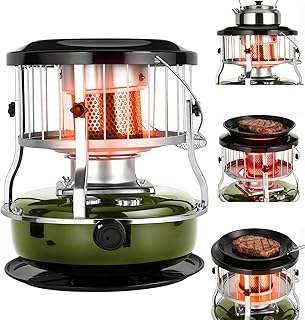
Best for: Buyers seeking a non-electric radiant heater with a cooking function and a stated 4.5-liter fuel capacity. The listing describes a 2-in-1 design for heating and cooking.
This model has a listed 9,000 BTU output and is described as warming spaces up to 15 square meters. It uses radiant heat, and the flame is controlled with a knob. The manufacturer information states up to 16 to 21 hours of operation after refueling, which is comparable to the other 4.5-liter model in this selection.
It is included as an alternative for buyers who want the same general combination of features in an army-green finish. The non-electric operation may be relevant for camping or emergency planning where electricity is unavailable, subject to the product’s approved use and safety directions.
Consideration: The supplied information does not state dimensions, weight, or specific cookware limits. Buyers who need verified compact measurements or a defined cooking-load capacity should check the product documentation first.
Buying Guide: How To Choose A Very Small Kerosene Heater
How small is the heater?
Compare the heater’s actual dimensions and weight rather than relying only on words such as “portable” or “compact.” Of these five listings, the green 9000 BTU model provides stated dimensions: 12.4 by 13.98 inches, with an adjustable height from 13.98 to 16.14 inches. The other supplied descriptions do not provide comparable measurements, so check their full specifications if storage space is limited.
Also consider how the heater will be moved and stored. A carrying handle, adjustable height, or an easy-storage design can make transport more manageable, but these features do not tell you the unit’s total weight. Confirm weight and storage requirements before purchase if you will carry it frequently or store it in a small vehicle.
What heat output and area do you need?
The products in this selection are listed at 9,000 BTU, except the AHUAWA model, which gives a range of 9,000 to 10,000 BTU. The listings also provide different coverage claims: up to 15 square meters for two radiant models, 30 square meters for VEVOR, and 107.64 to 161.46 square feet for the adjustable green model. AHUAWA lists 200 to 500 square feet.
These figures are not directly interchangeable guarantees. Room layout, insulation, outdoor conditions, ventilation, and heater placement can affect results. Choose a product whose stated capacity suits the intended area, but do not use a coverage claim as a substitute for following the manufacturer’s safety requirements.
How much runtime do you want between refills?
Listed runtimes range from 15 to 17 hours for the adjustable green model to up to 20 hours for VEVOR and AHUAWA. The two 4.5-liter models state 16 to 21 hours. Compare both the tank capacity and the claimed runtime, and remember that actual burn time can vary with operating conditions and flame settings.
A longer listed runtime may reduce the frequency of refilling, but fuel storage and refueling procedures matter too. Follow the product manual for approved fuel, filling, storage, and handling. Never refuel a hot or operating heater unless the manufacturer’s instructions explicitly provide a safe procedure.
Do you need a cooking surface?
All five listings describe a heater-and-stove or cooking function. VEVOR specifically states that its top supports cookware up to 33 pounds. The other supplied descriptions do not give a comparable cookware weight limit, so check their manuals before placing a pot or pan on the unit.
Choose a cooking-capable model only if you have a suitable, stable setup and the instructions permit the intended use. Heating and cooking involve open flame and hot surfaces. Keep cookware, fuel, and surrounding materials within the clearances specified by the manufacturer.
What safety information should you verify?
Kerosene heaters burn fuel and can create fire and carbon monoxide hazards. A product listing’s claim that a heater is suitable for indoor use does not replace the manual’s operating limits. Before buying, verify whether the exact model is approved for the setting where you plan to use it and follow its ventilation, clearance, ignition, shutdown, and maintenance directions.
Use a working carbon monoxide alarm as directed by its manufacturer, and keep the heater away from children, pets, combustible materials, and pathways. Do not operate a fuel-burning heater in a tent, vehicle, or enclosed room unless the product instructions specifically allow that use. If a listing does not provide clear safety documentation, seek clarification before purchase.
Which additional details should you compare?
- Fuel capacity: The listed tanks range from 1.22 gallons to 1.4 gallons, with two products specifying 4.5 liters and VEVOR specifying 5 liters.
- Adjustability: VEVOR lists adjustable height and flame; another model lists adjustable height.
- Accessories: AHUAWA lists a funnel, siphon pump, gloves, and extra wicks. Confirm that the delivered package includes the components described.
- Maintenance: Check the manual for wick care, cleaning, replacement parts, and storage instructions. The supplied product descriptions do not provide a full maintenance schedule.
- Use location: Verify indoor or outdoor restrictions for the exact model. A generic product description is not a substitute for model-specific instructions.
Frequently Asked Questions
What is the smallest kerosene heater in this list?
The green 9000 BTU portable model is the only product here with stated dimensions: 12.4 by 13.98 inches, with an adjustable height of 13.98 to 16.14 inches. The supplied information does not provide comparable measurements for the other models.
How long can a small kerosene heater run on one tank?
The listed estimates in this selection range from 15 to 17 hours up to 20 hours, while two models claim 16 to 21 hours. Actual runtime can vary by operating conditions and settings, so consult the product manual.
Can a kerosene heater be used indoors?
Only use a specific heater indoors if its manufacturer’s instructions allow that setting and explain the required ventilation and clearances. Do not rely solely on a retailer listing that calls a product an indoor heater.
Can these heaters cook food?
The product listings describe each heater as having a cooking function. VEVOR gives a specific cookware support limit of 33 pounds; the other supplied descriptions do not state a cookware weight limit. Follow the exact model’s instructions before cooking.
Which model is best for a power outage?
All five products are described as non-electric, so their heating functions are presented as operating without household electricity. Choose based on the verified safety instructions, fuel capacity, runtime claims, and space requirements for your intended emergency plan.
What safety equipment should I use with a kerosene heater?
Follow the heater and alarm manufacturers’ directions, including using a working carbon monoxide alarm where appropriate. Maintain required clearances and ventilation, and do not operate the heater in a restricted or enclosed setting unless the product documentation explicitly permits it.