The best wall hung fan heater depends on the room, installation requirements, and how you want to control heat. The DREO is best for buyers seeking app and voice control, while the QOWETU is a straightforward 1500W option with a remote. The HICFM is a higher-output choice for buyers who can use its specified 208V or 240V electrical supply. Compare the listed features below, and confirm each unit’s installation and electrical requirements before buying.
| Product | Best suited for | Listed standout |
|---|---|---|
| JNDRO Wall-Mounted Space Heater | Remote and thermostat control | Thermostat and remote in product name |
| QOWETU 1500W Electric Wall Heater | Buyers seeking a 1500W heater | Remote control |
| HICFM Electric Fan Wall Heater | Rooms needing higher heat output | 208V/240V operation and thermostat |
| GiveBest Smart Wall Space Heater | App and remote control | Remote and app in product name |
| DREO Smart Wall Heater | Scheduling and smart-home control | App, voice control, and 120° oscillation |
JNDRO Wall-Mounted Space Heater

The JNDRO is best for shoppers who want a wall-mounted heater with thermostat and remote control, as stated in its product name. Those features make it a relevant option for buyers who prefer adjusting heat without reaching the unit and want thermostat-based temperature control.
Choose this heater if those two controls are your main priorities. It was selected because it directly matches the wall-mounted fan-heater search and offers the named control features. The supplied product information does not specify its wattage, coverage area, oscillation range, or electrical requirements.
Limitation: Check the listing for output, room-size guidance, and installation details before deciding whether it fits your space. Buyers who need those specifications confirmed in advance may prefer a product listing that states them clearly.
QOWETU 1500W Electric Wall Heater

The QOWETU is best for buyers looking for a wall heater described as 1500 watts and supplied with remote control. The wattage gives shoppers a useful point of comparison with other heaters, while the remote is useful when the unit is mounted out of easy reach.
Choose this model if a 1500W rating and remote operation suit your needs. It was selected because the product name identifies both its wall-heater format and these buyer-relevant details. Compare its electrical requirements and the room size it is intended to heat with the room where you plan to use it.
Limitation: The provided product details do not state thermostat functions, coverage, oscillation, or safety features. Do not assume those capabilities are included; verify them in the current listing if they are important to your decision.
HICFM Electric Fan Wall Heater

The HICFM is best for buyers who need a higher-output wall heater and can accommodate the stated electrical supply. Its listed specifications give 4,000W and 13,650 BTU at 240VAC, or 3,000W and 10,236 BTU at 208VAC. The product description says it is designed for spaces up to 350 square feet and can provide warmth within 10 to 15 minutes.
It includes a built-in thermostat intended to maintain the selected temperature and an overheat protection feature. The description says a warning light turns on if the heater exceeds safe operating temperatures and that the safety control should be reset after the unit cools. These details make it a better fit for buyers comparing output and thermostat control than for someone seeking a basic low-output option.
Limitation: This model’s stated 208V/240V requirements are an important installation consideration. Confirm that the electrical supply and installation arrangement are appropriate before purchase; do not treat it as interchangeable with a 120V heater.
GiveBest Smart Wall Space Heater

The GiveBest is best for buyers who want both app and remote control, based on its product name. That combination can suit a household that prefers using a phone for heater control but also wants a separate remote. The listing title also describes it as an indoor wall space heater.
Choose this model if app-based control is a priority and you want a wall-mounted form factor. It was selected because those details align with buyers comparing smart wall heaters. The supplied product information does not specify the app’s functions, heating output, room coverage, thermostat range, or voice-assistant support.
Limitation: Check the current listing to confirm which app features are available and what electrical supply and room size the heater is designed for. Avoid choosing it solely because the word “smart” appears in the name if you need a particular scheduling or voice-control feature.
DREO Smart Wall Heater
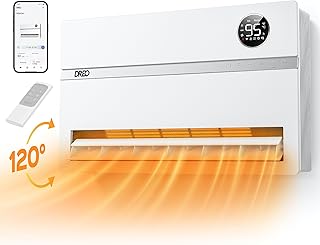
The DREO is best for buyers who value connected controls, scheduled operation, and broad air distribution. Its listed features include 120-degree oscillation, app access from anywhere, schedules, and voice control with Alexa and Google Home. It is a 1500W heater with a stated temperature-setting range of 41 to 95°F and 1°F accuracy.
Choose this model if those specific control features matter more than simply having a remote. The oscillation is intended to spread warm air more evenly, while scheduling can align heating with a daily routine. The product description identifies PTC ceramic heating and describes temperature control as fast and accurate.
Limitation: The supplied details do not state a recommended room size or electrical installation instructions. Confirm those points for your room and setup before buying, especially if you are comparing it with the HICFM’s explicitly stated coverage and voltage.
Buying Guide: How To Choose A Wall Hung Fan Heater
What size room do you need to heat?
Start with the room area and the heater’s stated coverage, when available. Of these five listings, the HICFM description specifies spaces up to 350 square feet. The other supplied product details do not provide a coverage figure, so check the current manufacturer or retailer information instead of assuming that a particular wattage will heat every room equally.
Room size is only one part of the decision. Insulation, ceiling height, drafts, and how cold the room gets can affect comfort. A wall fan heater is generally best treated as a room-level heating choice; do not assume it will heat an entire home or multiple closed rooms.
Does the electrical supply match the heater?
Check the voltage and power requirements before comparing convenience features. The HICFM lists operation at 208VAC or 240VAC, with different wattage and heat-output figures for each. The QOWETU is described as a 1500W heater, but the supplied information does not state its voltage. Verify each product’s electrical requirements and installation instructions before purchase.
If a heater’s stated voltage or installation method is unfamiliar, seek qualified advice rather than improvising an electrical connection. A product’s wall-mounted design does not by itself establish whether it plugs in or requires a particular wiring arrangement.
Which controls will you actually use?
A remote can be convenient when a heater is mounted above reach. A thermostat is useful for setting a target temperature, while app controls can add access from a phone. Scheduling is more specific: it lets a user set heating times according to the product’s capabilities. The DREO lists app access, scheduling, and Alexa and Google Home voice control; the GiveBest name identifies app and remote control, but its supplied details do not explain the app functions.
For a simpler control preference, compare the JNDRO, which is named as having a thermostat and remote, and the QOWETU, which is named as having a remote. Confirm control details in the current listing, including whether settings can be adjusted on the heater itself.
Is air distribution important?
Oscillation can move airflow across a wider area than a fixed direction, but the listed angle and design matter. The DREO specifies 120-degree oscillation. The other supplied descriptions do not provide a confirmed oscillation range, so compare their current product details if wide-area airflow is a deciding feature.
Think about where people sit and where the heater can be mounted. Positioning and the room layout can affect how useful the airflow feels. Follow the installation and clearance guidance provided with the chosen unit.
What safety information should you check?
Look for clear instructions about overheat protection, operating clearances, mounting, and any reset procedure. The HICFM description specifically states that it has overheat protection, a warning light, and a safety control that should be reset after cooling. Do not assume the other products have the same protections based only on their category or product name.
Use a wall heater in accordance with its manual, keep required clearances, and avoid obstructing airflow. If the listing does not clearly explain installation or safety features, consult the manual or seller information before deciding.
How should you compare the five options?
- For app and voice features: The DREO lists app scheduling and Alexa and Google Home compatibility.
- For a specified higher output: The HICFM lists 3,000W at 208VAC or 4,000W at 240VAC, with corresponding BTU figures.
- For 1500W and remote operation: The QOWETU is named as a 1500W wall heater with remote control.
- For app and remote control: The GiveBest product name includes both; confirm the app’s available functions.
- For thermostat and remote control: The JNDRO product name identifies both features; verify output and coverage.
Use the details that are explicitly stated to narrow the shortlist, then confirm missing specifications. A clear match for room size, voltage, controls, installation, and safety matters more than choosing a heater based on a single feature.
Frequently Asked Questions
What is a wall hung fan heater?
A wall hung fan heater is an electric heater mounted on a wall that uses fan-driven airflow to distribute heat. Product designs and installation requirements vary, so check the individual heater’s instructions and specifications.
Is a 1500W wall heater suitable for a large room?
Wattage alone does not confirm suitable room coverage. Check the manufacturer’s stated room-size guidance and consider insulation, drafts, and ceiling height. The supplied QOWETU information identifies 1500W but does not provide a coverage figure.
Which listed heater has app and voice control?
The DREO description lists app access, scheduling, and voice control through Alexa and Google Home. The GiveBest product name mentions app and remote control, but the provided details do not specify voice compatibility.
Does the HICFM heater use a standard 120V outlet?
The supplied HICFM specifications state 208VAC or 240VAC operation, not 120VAC. Confirm the full installation requirements before buying and do not assume it can use a standard 120V supply.
Is oscillation necessary in a wall fan heater?
No. Oscillation is useful when you want airflow to move across a wider area, but a fixed-direction heater may suit a more focused heating position. The DREO lists 120-degree oscillation; the supplied details for the other products do not confirm an oscillation range.
What should I verify before installation?
Confirm the heater’s voltage, wattage, mounting requirements, clearances, coverage guidance, and safety instructions. For a model with unfamiliar electrical requirements, get qualified help before installation.